



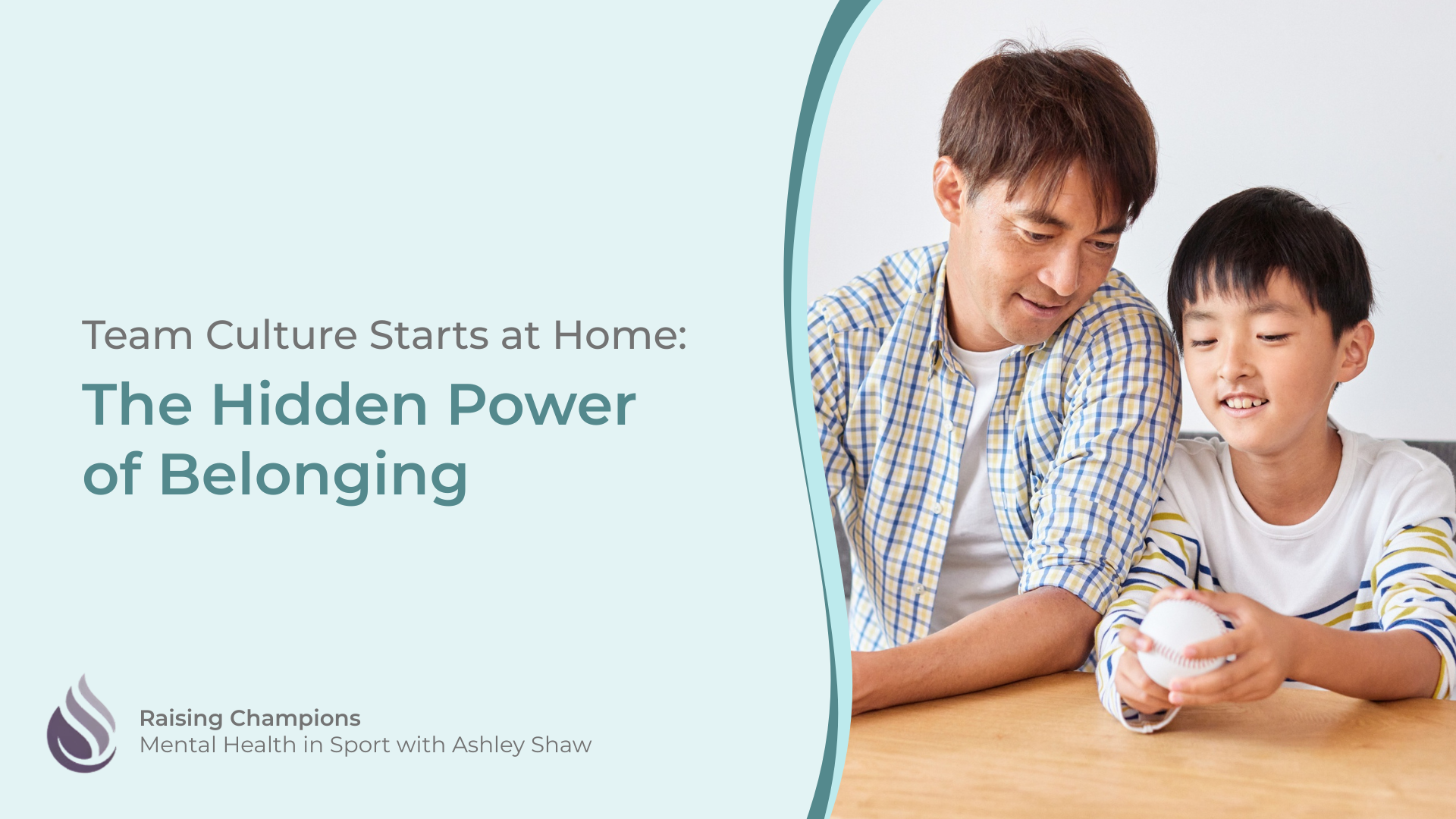
08 Dec Team Culture Starts at Home — The Hidden Power of Belonging
I once asked a teenage basketball player what he loved most about his team.
He said, “Even when we lose, we still joke around on the bus.”
That answer stopped me in my tracks.
Because what he described wasn’t just team chemistry — it was belonging.
What Belonging Actually Is
Belonging isn’t about fitting in. It’s about feeling safe to be yourself.
When a child knows they’re valued — not just for their performance, but for their presence — they play differently.
They take healthy risks, recover faster from mistakes, and connect more deeply with others.
In psychology, belonging is one of the most powerful buffers against stress and burnout.
It tells the nervous system, “You’re safe here.”
Why It Starts at Home
Every team culture begins in the home.
The way parents talk about effort, mistakes, and teammates shapes how a child behaves in a group.
I see this all the time in my Calgary practice.
Families who celebrate process over outcome — “I loved how focused you were” instead of “You scored the most” — raise kids who are humble, confident, and kind teammates.
But when home becomes performance-oriented — “Did you win?” “Why didn’t you score?” — the pressure follows them onto the ice or court.
A Story from My Office
A 10-year-old soccer player once told me, “I hate the car ride home.”
Not because his parents yelled — but because they debriefed.
They analyzed every missed pass, every goal, every “should have.”
He said, “I just want to listen to music.”
Now, that family’s post-game ritual is quiet car rides — maybe ice cream, maybe silence.
And his enjoyment (and performance) has skyrocketed.
Creating Belonging in Everyday Life
Parents can foster belonging by:
- Using “we” language. (“We’ll get through this together.”)
- Acknowledging effort. (“You worked hard — that’s what matters.”)
- Making space for laughter. It resets the nervous system faster than any pep talk.
Final Thought
Every child deserves a home that feels like a safe team.
Because the strongest athletes aren’t driven by fear — they’re grounded in belonging.
At Still Waters Psychology Calgary, I help parents and coaches create emotionally intelligent environments where confidence grows naturally — one safe connection at a time.
No Comments